
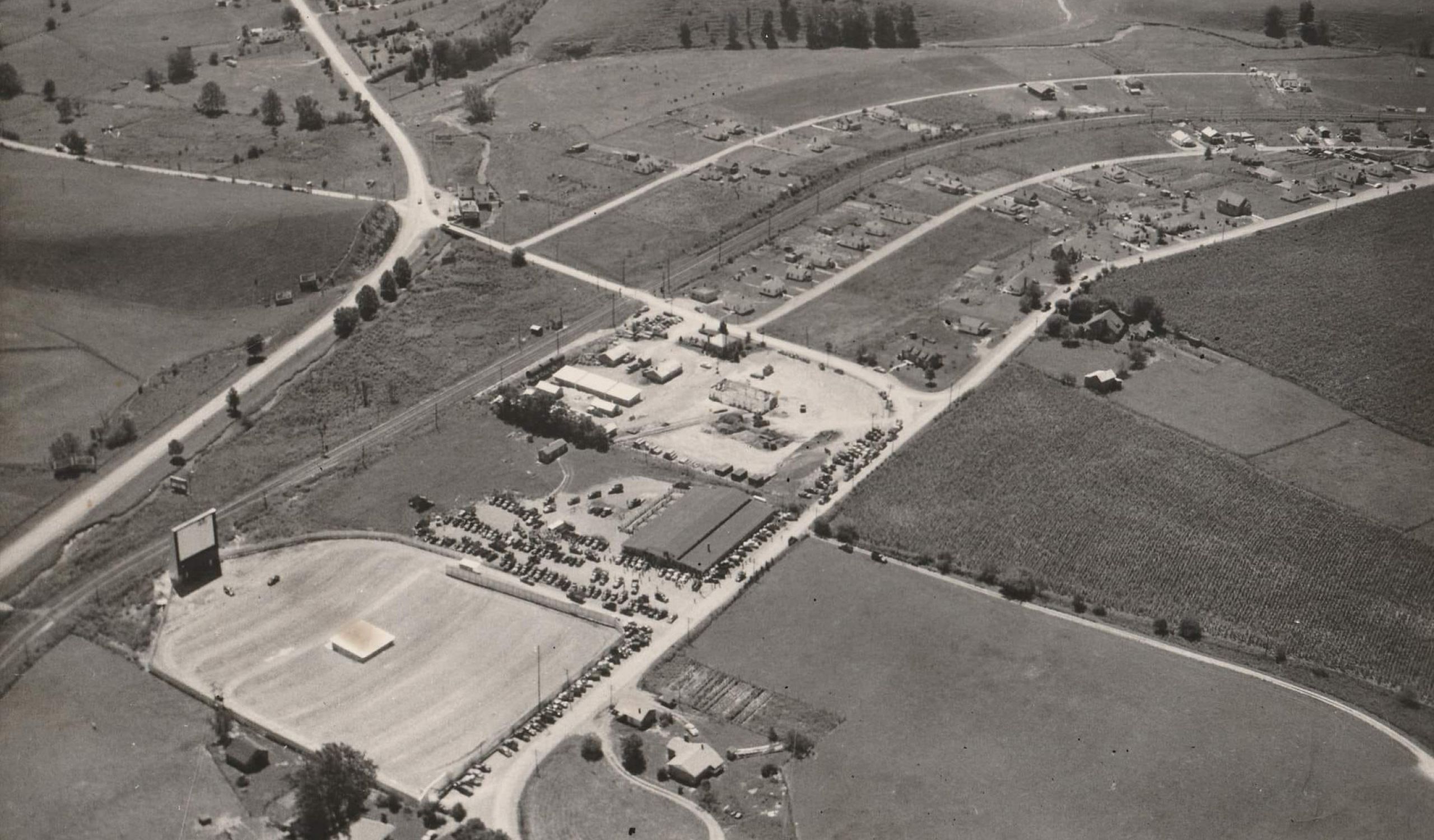
There is a photograph of the old Four-Way area of Tazewell that I keep returning to. Taken from above, it shows a landscape that seems both familiar and almost impossible to recognize. Fields stretch between narrow roads. Houses sit apart from one another. And in the lower corner stands a tall outdoor movie screen, facing a broad clearing where cars once gathered after dark.
That was the Sunset Drive-In. Today, the Food Lion occupies the site.
To someone who never knew the theater, this might be an interesting photograph of an earlier Tazewell. To those of us who went there, it opens a door. You can remember people, conversations, a particular car, the anticipation of waiting for the picture to begin. A photograph doesn’t make the place come back, exactly, but it can bring you surprisingly close.
The Sunset opened on August 22, 1950, with room for approximately 300 cars. Its early history was tied to T. D. Field, a regional theater businessman whose interests also included the Clinch and Valley theaters. The Hughes brothers acquired the Sunset in 1963, and it continued operating until 1984. For thirty-four years, a field at Four-Way became a place where this part of Southwest Virginia went to the movies.
I was one of those children, going in the mid-to-late 1970s. And I have to admit something: we were sometimes hidden in the truck so nobody would have to pay admission for us. I still laugh about that. Families found ways to make a dollar go a little farther, and apparently ours had a rather creative approach to the ticket gate.
I don’t pretend to remember every movie I watched there. What has lasted is the experience of going. The drive-in made an ordinary evening an event. You traveled to it. You waited with everyone else. And for a few hours, the familiar world gave way to somewhere else.
That mattered to me growing up in the mountains. Not because there was anything wrong with where we lived, but because the imagination is never satisfied by a single horizon. A movie could take us to another country, another time, even another planet, and then send us back along the same roads we knew by heart. The mountains were still there when the credits ended, but we had glimpsed something beyond them.
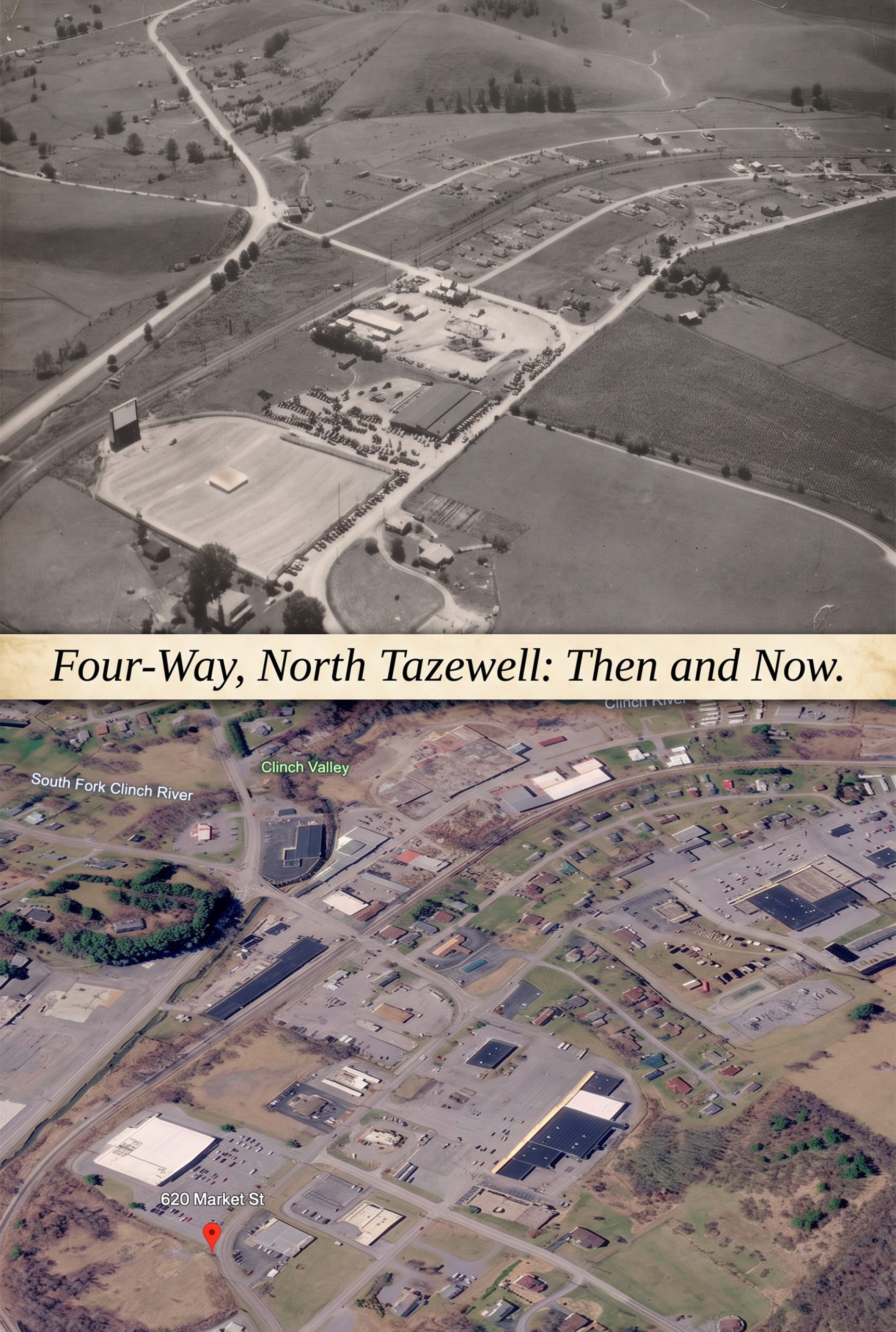
By the early and middle 1980s, the way we watched movies was changing. Videocassette recorders and VHS rentals made it possible to bring the movie home. We didn’t have to wait for a theater to schedule the film we wanted or hope it came through town. We could choose it ourselves.
I remember Beyond Video in Tazewell becoming a hot spot. There was something genuinely exciting about being able to walk in, look through the available movies, and decide what we wanted to watch. The selection itself became part of the evening. You might go in certain you knew what you wanted and come out carrying something entirely different. The box art, the descriptions, the recommendations, and the small negotiations over what everyone in the house would agree to watch all became their own kind of entertainment.
It was freedom of a different sort. At the Sunset, we went where the movie was. With VHS, the movies came to us.
The change was remarkable, particularly for a generation that had grown up with only a few television channels and whatever the local theaters happened to be showing. Suddenly, a family in Tazewell could assemble its own movie night. We could revisit a favorite, discover an older picture, pause for supper, rewind a scene, or watch again the next day. The world beyond these mountains felt a little closer, and we had more say in which part of it we wanted to see.
But it wasn’t quite the same.
The drive-in had required us to go somewhere together. It had a ticket gate, a screen, other cars, and a certain sense of occasion. The video store replaced that outing with another ritual: choosing a movie, taking it home, remembering to return it. It was more convenient and, in many ways, more personal. Yet each new convenience changed what we shared in public.
Then came DVDs, mail-order rentals, and streaming. The shelves and plastic cases began disappearing. The trip to choose a movie was replaced by a menu on a television. One of our long-standing local video rental stores finally closed only a few years ago, long after the business model seemed to have disappeared almost everywhere else. I remember thinking how remarkable it was that a place like that had held on for so long.
Now we can summon more movies than we could have imagined as children, almost instantly. That is a wonderful thing. I wouldn’t argue otherwise. But having more to choose from does not automatically make an evening more memorable. Sometimes I think what we miss isn’t the old technology at all. We miss the small rituals around it, and the people who were there.
The Sunset and Beyond Video belonged to two different eras, yet both offered the same essential gift. They let us travel beyond what we could see from home. One brought a community into a field beneath the night sky. The other let us carry a piece of that larger world through the front door.
That is the heart of What We Didn’t Keep, a companion to our What We Kept exhibition at Haus of Taylor. This isn’t an argument that everything old was better, or that change should have stopped. Towns grow. Businesses open and close. Technology reshapes habits. But places can vanish so completely that a younger generation never knows what stood there, and with them go the little details that formal histories rarely record.
A theater’s opening date can be documented. So can its owners and the year it closed. A business directory can tell us where a video store stood. What those records cannot tell us is whose first date happened there, which family argued over a Friday-night rental, or who was quietly tucked into a truck to save the price of a child’s ticket.
Those stories live with us, and they are worth bringing into the light.
When I look at that aerial photograph now, I don’t just see the Sunset Drive-In or the future site of a grocery store. I see how one generation of entertainment gave way to another, and how each left a mark on the people of this valley. The buildings, screens, and shelves may not have survived. The curiosity they encouraged did.
Maybe that is one of the most important things we kept.
If you remember the Sunset Drive-In, Beyond Video, or another Tazewell movie-rental shop, we would love to hear your stories. Which movies do you remember? Who took you? What else can you identify in the aerial photograph? Your memories can help preserve the history that official records leave out.


